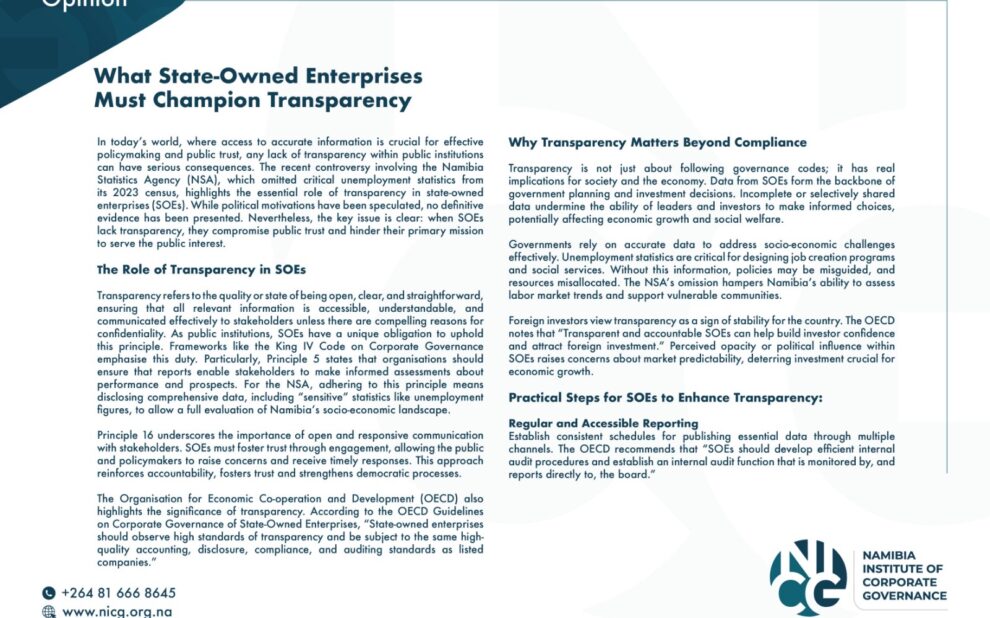
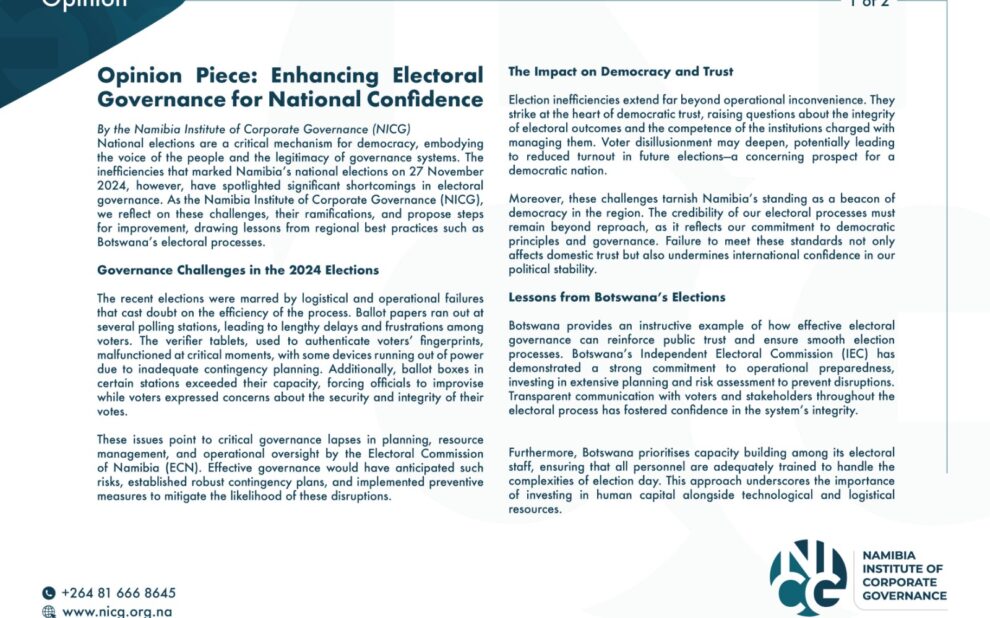
Weak Governance in SOEs
1) Governance risks of prolonged ‘acting’ CEO appointments, and whether acting CEOs can drive long-term strategy From a governance and…
1) Governance risks of prolonged ‘acting’ CEO appointments, and whether acting CEOs can drive long-term strategy From a governance and…
GOVERNANCE AS RESILIENCE INFRASTRUCTURE: NICG Reflections on Environmental and Disaster Management in Namibia The Namibia Institute of Corporate Governance (NICG)…
As 2025 comes to an end, we take a moment to reflect on a year of growth and collaboration in…
Introduction The second NICG Governance Conference took place on 22 October 2025 under the theme Governance in a Transformative Era.…
We, the Namibia Institute of Corporate Governance (NICG), issue this view as our considered assessment of King V and its…
The NICG Governance Conference, held on 22 October 2025, brought together some of Namibia’s most respected voices in leadership and…
Read the full article below.
View full article here
GOVERNANCE RANKING STUDY The Namibia Institute of Corporate Governance (NICG), in collaboration with the Department of Public Enterprises under the…
We are pleased to invite your organisation to participate in the upcoming Women on Boards Masterclass, taking place on 23–24 June 2025 at Am…
Join industry leaders, governance experts, and decision-makers for two days of insightful discussions, networking, and thought leadership.
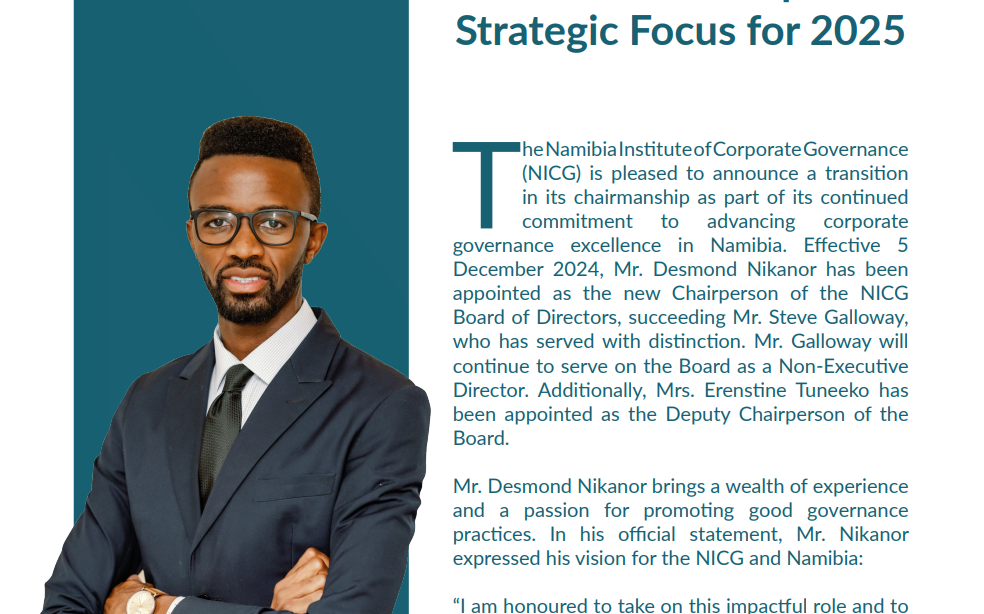
The Namibia Institute of Corporate Governance (NICG) is pleased to announce a transition in its chairmanship as part of its…
Imagine sitting in your first board meeting, surrounded by seasoned executives. The CEO has just finished presenting a bold new…
As the Institute embarks on the next phase of the journey of advocating, entrenching and protecting good corporate governance in all organisations and governing bodies, we rely on the solid foundations established by the first board of directors under the visionary leadership of Escher Luanda and Libertha Kapere.
We also rely on the firm commitments made to best practice in governance at the national level in national development plans and in the Harambee Prosperity Plan II(2021-2025). We are privileged to have amongst our founder members some of the best examples of good corporate governance practice anywhere in the world. We intend to cascade this best practice through the business, governmental enterprise and non-governmental organisation segments in Namibia, including to small-, medium- and micro-organisations and community structures through office bearers on all governing bodies.
If we define corporate governance, as King IV does, as “The exercise of ethical and effective leadership by the governing body towards the achievement of the following outcomes: Ethical Culture; Good Performance; Effective Control, and Legitimacy”, then these outcomes can be applied to any organisation and its leadership.
In addition to the shifts to outcomes-based governance in modern best-practice, the entrenchment of ethical values and practice have become the cornerstone of good corporate governance. The move away from the primacy of the shareholder to stakeholder-centricity have further built on the African tenets of community values as described by the concept of ‘’Ubuntu’’ in African leadership doctrines and governance codes over the past few decades. In very simple terms, these tenets teach us ‘’to do the right thing- do as your community elders expect of you, which actions your children and their children would be proud of’’. By doing this we will leave a better world than the one we found.
The accelerating alignment and integration of financial and sustainability accounting and reporting standards and practice has heralded possibly the most significant nexus for corporate governance in a generation. It is our privilege and responsibility to be the custodians of best practice in Namibia during this watershed period. The tidal wave of ’’ESG’’ we see breaking around the globe provides the unique opportunity to embrace one comprehensive global standard for sustainability, while at the same time hopefully creating the flexibility to implement regional and national imperatives in each of the Environmental, Social and Governance factors which are appropriate to local circumstances.
At the Namibian Institute of Corporate Governance we will continue to champion corporate governance leadership and the advocacy, custodianship and implementation of best practice for the benefit of all our stakeholders.

As the Institute embarks on the next phase of the journey of advocating, entrenching and protecting good corporate governance in all organisations and governing bodies, we rely on the solid foundations established by the first board of directors under the visionary leadership of Escher Luanda and Libertha Kapere.
We also rely on the firm commitments made to best practice in governance at the national level in national development plans and in the Harambee Prosperity Plan II(2021-2025). We are privileged to have amongst our founder members some of the best examples of good corporate governance practice anywhere in the world. We intend to cascade this best practice through the business, governmental enterprise and non-governmental organisation segments in Namibia, including to small-, medium- and micro-organisations and community structures through office bearers on all governing bodies.
If we define corporate governance, as King IV does, as “The exercise of ethical and effective leadership by the governing body towards the achievement of the following outcomes: Ethical Culture; Good Performance; Effective Control, and Legitimacy”, then these outcomes can be applied to any organisation and its leadership.
In addition to the shifts to outcomes-based governance in modern best-practice, the entrenchment of ethical values and practice have become the cornerstone of good corporate governance. The move away from the primacy of the shareholder to stakeholder-centricity have further built on the African tenets of community values as described by the concept of ‘’Ubuntu’’ in African leadership doctrines and governance codes over the past few decades. In very simple terms, these tenets teach us ‘’to do the right thing- do as your community elders expect of you, which actions your children and their children would be proud of’’. By doing this we will leave a better world than the one we found.
The accelerating alignment and integration of financial and sustainability accounting and reporting standards and practice has heralded possibly the most significant nexus for corporate governance in a generation. It is our privilege and responsibility to be the custodians of best practice in Namibia during this watershed period. The tidal wave of ’’ESG’’ we see breaking around the globe provides the unique opportunity to embrace one comprehensive global standard for sustainability, while at the same time hopefully creating the flexibility to implement regional and national imperatives in each of the Environmental, Social and Governance factors which are appropriate to local circumstances.
At the Namibian Institute of Corporate Governance we will continue to champion corporate governance leadership and the advocacy, custodianship and implementation of best practice for the benefit of all our stakeholders.